

The 482 visa plays a significant role in Australia’s immigration framework, providing a pathway for skilled workers to enter and work in the country through employer sponsorship.
This visa type addresses the needs of Australian businesses facing skills shortages by allowing employers to sponsor suitable overseas candidates for specific roles. Understanding the 482 visa and the skills currently in demand is crucial for both employers and prospective applicants navigating the immigration process.
Overview of the 482 Visa
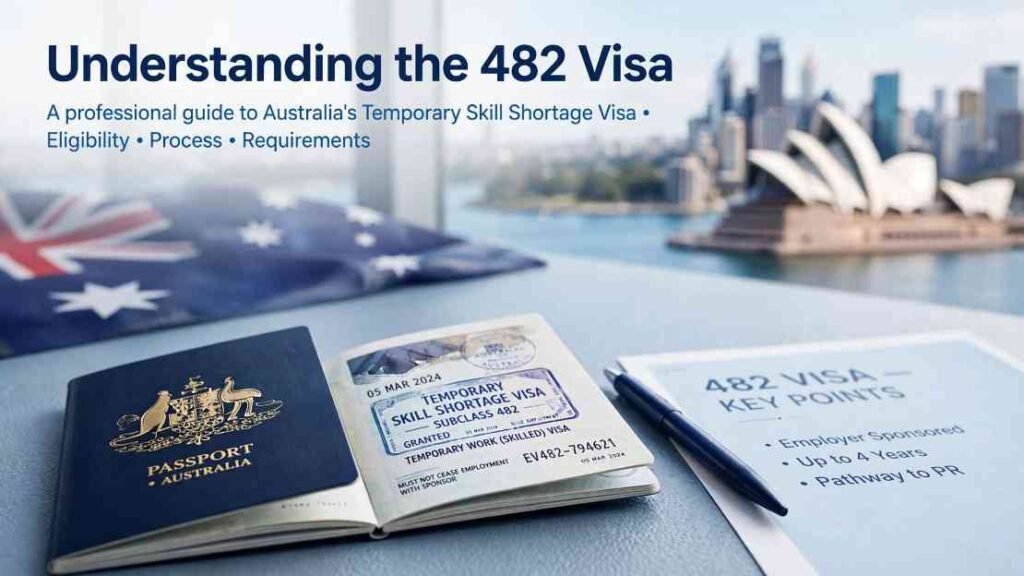
The 482 visa, also known as the Temporary Skill Shortage visa, facilitates temporary employment in Australia for overseas workers when qualified Australians are not available for the position. This visa replaced the former subclass 457 visa in 2018, introducing new regulations to ensure that the programme better meets Australian labour market needs. It allows skilled workers to stay and work in Australia for up to four years, depending on the nominated occupation and stream.
Streams of the 482 Visa
The 482 visa has three primary streams designed to cater to various employment requirements.
Short-Term Stream
This stream applies to occupations listed on the Short-Term Skilled Occupation List (STSOL) and allows visa holders to work in Australia for up to two years, with a possibility of extension to four years in some cases. It is suitable for employers seeking to fill temporary skill shortages.
Medium-Term Stream
This stream covers occupations on the Medium and Long-term Strategic Skills List (MLTSSL) and the Regional Occupation List (ROL). It allows visa holders to work in Australia for up to four years and offers pathways to permanent residency. It is most appropriate when employers require long-term solutions to skill shortages.
Labour Agreement Stream
This stream requires employers to have a labour agreement with the Australian government. It is applicable when the standard occupation lists do not meet a business’s specific needs, offering greater flexibility in hiring international workers.
Skills in Demand Under the 482 Visa
Understanding the occupations currently in demand under the 482 visa is essential for both employers and applicants. The Australian government regularly reviews and updates the occupation lists to align with economic needs.
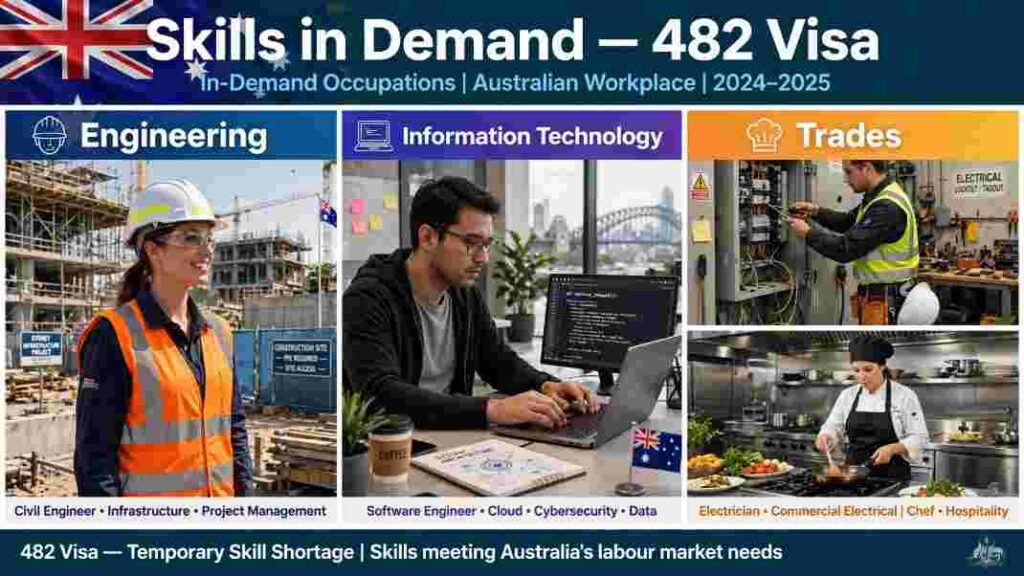
Occupations on the 482 visa lists include a mix of professional, technical, and trade roles. For example, healthcare professionals such as registered nurses, medical practitioners, and aged care managers are highly sought after.
Engineering disciplines, including civil engineers, electrical engineers, and mechanical engineers, also feature prominently. Additionally, information technology specialists like software engineers and developers remain in demand.
Healthcare Sector Demand

The healthcare industry continues to experience significant skill shortages across Australia. The ageing population and expanding healthcare services create a sustained need for qualified medical professionals under the 482 visa program. Positions such as general practitioners, registered nurses, and aged care managers are commonly included in the medium-term stream due to their ongoing demand.
Engineering and Technical Occupations
Engineering occupations are vital to Australia’s infrastructure development and resource sectors. Civil, electrical, and mechanical engineers are among the most requested roles under the 482 visa. These occupations present opportunities for skilled migrants seeking medium-term stay and potential permanent residency pathways.
Information Technology Roles
The rapid evolution of technology and digital transformation in various industries drive the demand for IT specialists. Software engineers, developers, and system analysts are consistently listed on the medium-term occupation list. Employers sponsoring skilled IT workers benefit from access to specialised expertise that supports innovation and competitiveness.
Trade and Technical Occupations
Alongside professional roles, certain trade occupations are included on the short-term list. Electricians, plumbers, and chefs are examples of occupations which may qualify under the short-term stream. These skilled trades contribute to construction, hospitality, and other key sectors where immediate skill shortages exist.
Requirements for Employers Sponsoring 482 Visa Holders
Employers seeking to sponsor overseas workers under the 482 visa must meet specific criteria. These include demonstrating a genuine need for the nominated occupation, proving compliance with labour market testing requirements where applicable, and showing commitment to training Australian workers.
Additionally, sponsoring employers must be approved by the Australian government and meet particular financial and operational criteria. To meet financial criteria, applicants should learn to save money fast on a low income. This process ensures that sponsorship contributes positively to the Australian workforce while preventing reliance on overseas labour without appropriate justification.
Eligibility Requirements for Applicants
Applicants for the 482 visa must satisfy several qualification and experience prerequisites. These include having relevant skills, suitable English language proficiency, and health and character clearances. Depending on the stream, an applicant’s nominated occupation must be on one of the specified occupation lists.
Pathways to Permanent Residency
One of the attractive features of the medium-term stream of the 482 visa is the eligibility for permanent residency after a period of work in Australia. This provides an avenue for skilled migrants to settle permanently and contribute long-term to the nation’s economy and society.
Challenges and Considerations
While the 482 visa offers opportunities, it also poses challenges for applicants and employers. Navigating the requirements and changing regulations requires expert advice and careful planning. Applicant should be skillful and have sustainable finance strategy and to achieve that applicant should stop overspending and take control of your money. Labour market testing and compliance conditions necessitate detailed documentation and procedural rigour.
The Role of Migration Agents and Professional Advice
Given the complexity of Australian employer-sponsored visas, many prospective employers and visa applicants seek assistance from registered migration agents or immigration firms. Professional guidance ensures applications are correctly completed, increasing the likelihood of approval and compliance with legislative changes.
Conclusion
The 482 visa remains a critical tool in addressing Australia’s skills shortages through employer-sponsored immigration. Awareness of the skills in demand under this visa and adherence to relevant requirements supports both employers and skilled foreign workers in achieving successful outcomes.
Those interested in exploring opportunities under the 482 visa should consider consulting authoritative sources and immigration professionals to understand the latest updates and eligibility criteria.